A Shakespeare Festival in 1769
August 22, 2010 by ciji · Leave a Comment
 The three actors on your left are performing this summer in New York Classical Theater‘s production of Much Ado About Nothing presented in Central Park. (The handsome gent in the middle is my brother-in-law, Christopher Cass, playing Don Pedro, Prince of Aragon as a Naval officer!)
Shakespeare festivals have been going on so long, their organizers are constantly searching for new interpretations–and certainly new “settings” for some very old plays. This Much Ado is set in 1945 during World War II. (Well, why not?)
It got me thinking as I am readying a new edition of my historical novel, Wicked Company for publication in October of this year from Sourcebooks Landmark. My book centers on the life of the women playwrights whose works were produced to great success at London’s Covent Garden and Drury Lane theaters in the last half of the 18thc.
David Garrick, the actor-manager of Drury Lane, was not only credited with mentoring women playwrights, but also with being the finest Shakespearean actor of his day. As one wag put it, “Garrick elevated the Bard from able dramatist to a God.”
Recently I was proofing the section dealing with the heroine Sophie McGann’s role assisting at Garrick’s famous (some say infamous) Shakespeare Jubilee held on the banks and in the village of Stratford-Upon-Avon in September of 1769. Sadly, the skies opened up and it virtually poured buckets of rain during the entire three-day event, nearly drowning the actors and audiences alike.
Garrick had summoned the finest thespians of the day to join him in the tribute held in Shakespeare’s birthplace, and redeemed the soggy disaster by presenting his “Ode to Shakespeare” –a performance that eyewitnesses said brought down the house (a rotunda, actually) as the water was rising and soaking the slippers of the entire audience. The scholars and intellectuals of the day, including Garrick’s supposed friend, Samuel Johnson, boycotted the event.
 On the left is a highly idealized image of Garrick reciting his Ode. Ever the entrepreneur, he re-staged the washed-out “Parade of Shakespeare Characters” back in London, and whenever the billboards trumpeted the most famous actor of his day was–again–to deliver his Ode to Shakespeare, the house was packed.
Last week, my poor brother-in-law performing Shakespeare outdoors had a similar experience to Garrick ‘s and his actors in 1769. Chris’s Sunday, August 15th performance of Much Ado on the grass in Central Park was just that: nothing. It was rained out!
So what’s new?
18th c. Actor-Manager David Garrick–A Feminist?
August 15, 2010 by ciji · Leave a Comment
 One of the great delights in researching my up-coming October release of Wicked Company from Sourcebooks Landmark was discovering that David Garrick, the fabled actor-manager of the eighteenth century London Theater Royal, Drury Lane, was what we surely would call in our own age, “a feminist.”
For the nearly thirty years of his sterling career, he championed women artists–not only actresses, but dancers, novelists and playwrights as well. Here on the left in a portrait by Hogarth, he is shown at his desk, no doubt penning one of his own plays which competed with the immortal likes of She Stoops to Conquer and The School for Scandal.
Garrick was also known for another oddity of his age and ours: an absolute devotion to his wife, Eva-Maria, pictured behind him as a kind of bright yellow “happy muse.”
In the eighteenth century, with no television or motion pictures to steal his audiences–Garrick changed the playbill every few days or so. He also offered dancing, singing, and other divertissments in a bold attempt to keep his fickle patrons from heading over to his nearby arch rival, Theater Royal, Covent Garden. This constant revolving of “What’s on tonight at Drury Lane?” required, however, a never-ending need for new material.
With great respect for the professional life his wife had enjoyed as a premier dancer of her day, Garrick was only too happy to hire talent, whatever its gender, to keep the public’s interest in the kinds of entertainment offered at Drury Lane, and in fact, he encouraged women writers by offering them his services as mentor and editor as they toiled on their plays.
Garrick launched a number of women in well-paid careers as “petticoat playwrights,” among them the actress, comedienne Kitty Clive (1711-1785), seen here on the right. He also served as cheerleader to one of the playwriting “Hannahs”–Hannah More . (The other, Hannah Cowley ,and Hannah More actually despised each other–but you will have to read Wicked Company to learn more about that!).
 When I was first researching this historical novel at the Huntington Library and Art Galleries in the late 1980’s–as seen here on the left–there was very little published about Garrick’s role in launching these women into professional writing careers. But soon I was bumping into theater scholars from Ohio, Delaware, and Yale universities and elsewhere, hard at work on such nonfiction efforts as Curtain Call: British and American Women and the Theater 1660-1820, and The Plays of Frances Sheridan (mother of Richard, of The School for Scandal and The Rivals fame). Garrick produced one of Frances Sheridan’s work, The Dupe, though, sadly, it found little favor with the sometimes riotous, badly-behaved audiences.
David Garrick died in 1779, and much later, a London social club was named in his honor. When I was in London researching Wicked Company, I was taken there as a guest on the only day a woman could enter those portals because–of course, The Garrick Club was founded by men, and as far as can be determined, remains for men only.
Ah, the ironies of history…
A Tale of Two Covers
August 8, 2010 by ciji · Leave a Comment
Anyone who follows the publishing business knows what turmoil the industry has been experiencing since the Dawn of the Digital Age changed all the rules and even the game itself. Nowhere is that upheaval more likely to be felt than in the marketing of books.
I’ve been a frontline witness to this recently. Last Spring I was sent the new cover for Wicked Company, the October Sourcebooks Landmark release of a novel that’s very dear to my heart because it’s about writers; specifically women writers struggling to make their way in the boistrous, bawdy 18th c. world of the famed Drury Lane and Covent Garden theaters. Between 1660 and 1820, there were at least one hundred “petticoat playwrights” who saw their works mounted on the professional stage–many writing under their own names. As an author rather obsessed with the question “what were the women doing in history?”, to me, these amazing artists were perfect fodder for an historical novel.
 The cover on the left was sent for my approval last spring and I loved it. The image was an adaptation of the famous Sir Joshua Reynolds portrait of perhaps the most celebrated 18th c. actress-manager in England, Sarah Siddons. Huge in size and grand in scope, it currently hangs at the Huntington Art Gallery in San Marino, California, where I spent several years researching Wicked Company.
Then a funny thing happened on the way to publication day for the new edition: some very key people in the process of getting the book to market had second thoughts about the cover, so back to the drawing boards they went to see if they could both capture the era, as well as reflect a less “static” feeling in presentation, as one book buyer put it.
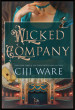
The final cover is now this you see on the right:  showing a slightly mysterious image of an actress on stage in period dress, framed by red velvet drapes and also sporting the shield that has become a welcome “signature” for this series of my books.
I cannot deny the cover switch hasn’t required some adjustment, as I’d already put it on my new website and was quite pleased about the way it harmonized with the other Sourcebooks Landmark covers in the new series. However, I realize that those professionals who specialize in bringing historical novels to their audiences in this sometimes perplexing digital revolution may know much more about the business of “packaging” and “buyer appeal” than I do, and are wise in the ways of trends in the evolving industry.
Thus, I remain grateful to the talented designers at my publishers who have now created two attractive covers for Wicked Company, and I leave it to the readers of this blog to decide which of the images attracts them the most to a book that was such a joy for this author to write. The cover on the right is the one that will appear in the bookstores, but you, faithful reader, now have the inside scoop on why you may have seen Sarah Siddons vanish back to the eighteenth century.
It’s a new world out there in publishing with books now also available on Kindle, iPad, Nook, and Sony readers, as well as the old fashion volumes made from paper that you can hold in your hands and turn the pages–while soaking in a bathtub!
Let me know what you think, both about the book’s cover and its contents…
Why a Race To Splendor?
August 1, 2010 by ciji · Leave a Comment

Meet Julia Morgan, the first licensed woman architect in California
My husband and I “met’ this extraordinary person when we moved to San Francisco eleven years ago and ended up living in a building designed by her shortly after the cataclysmic 1906 San Francisco earthquake and firestorm. She, of course, was the very woman who (finally) won the commission to restore the Fairmont Hotel (as I mentioned in my previous blog post), a few blocks from where we first lived on Nob Hill.
Our building on the corner of Taylor and Jackson streets had been commissioned by a woman physician. San Francisco was still considered the Wild, Wild West at the turn of the twentieth century, so perhaps a woman doctor was admitted into the local medical fraternity because there weren’t many doctors at all in California in those days. Read more
A new novel – A Race to Splendor
July 26, 2010 by ciji · Leave a Comment
 For those of you who have traveled to San Francisco (and those of us lucky enough to live in the Bay Area), the building on the left is actually a familiar landmark: the fabled Fairmont Hotel atop Nob Hill.
However, look closely…this is a vintage photograph from shortly after the catastrophic 1906 San Francico earthquake and firestorm that left some 250,000 San Franciscans homeless and living in the Presidio for up to two-and-a-half years, first in tents, and later in what came to be know as “earthquake shacks” — one room wooden structures that were marginally larger than outhouses!
My son bought me this image several years ago when I had been in the middle of writing my new historical novel A Race to Splendor. As you can see, the hotel itself–three days away from its official opening in April, 1906–survived the quake very well, on the outside, at least. The brutal fire ripped through the interior, virtually melting everything in its wake, including the spectacular Tiffany atrium in the lobby. Some of the floors fell seven feet, and the structure was basically an empty shell, and an extremely challenging engineering project to put to rights.
The story of how the hotel was restored “reads like a novel” and so I wrote one! The famous New York architect, Stanford White, initially won the commission, but then a very bad thing happened to him (if you don’t know your early 20th c. history, you’ll just have to read the book when it debuts in April, 2011, from Sourcebooks-Landmark on the 105th anniversary of the quake!), and Julia Morgan, the first licensed woman architect in California, inherited the restoration job.
A Race to Splendor focuses on the whirlwind competition between hotels to get up-and-running by the first anniversary of the quake in April, 1907 to prove to the world that the City by the Bay would rise from the ashes, putting-to-lie those who said she was like “Pompeii, never to rise again….”
Read more