A Tale of Two Covers
August 8, 2010 by ciji · Leave a Comment
Anyone who follows the publishing business knows what turmoil the industry has been experiencing since the Dawn of the Digital Age changed all the rules and even the game itself. Nowhere is that upheaval more likely to be felt than in the marketing of books.
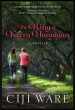
I’ve been a frontline witness to this recently. Last Spring I was sent the new cover for Wicked Company, the October Sourcebooks Landmark release of a novel that’s very dear to my heart because it’s about writers; specifically women writers struggling to make their way in the boistrous, bawdy 18th c. world of the famed Drury Lane and Covent Garden theaters. Between 1660 and 1820, there were at least one hundred “petticoat playwrights” who saw their works mounted on the professional stage–many writing under their own names. As an author rather obsessed with the question “what were the women doing in history?”, to me, these amazing artists were perfect fodder for an historical novel.
 The cover on the left was sent for my approval last spring and I loved it. The image was an adaptation of the famous Sir Joshua Reynolds portrait of perhaps the most celebrated 18th c. actress-manager in England, Sarah Siddons. Huge in size and grand in scope, it currently hangs at the Huntington Art Gallery in San Marino, California, where I spent several years researching Wicked Company.
Then a funny thing happened on the way to publication day for the new edition: some very key people in the process of getting the book to market had second thoughts about the cover, so back to the drawing boards they went to see if they could both capture the era, as well as reflect a less “static” feeling in presentation, as one book buyer put it.
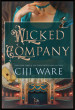
The final cover is now this you see on the right:  showing a slightly mysterious image of an actress on stage in period dress, framed by red velvet drapes and also sporting the shield that has become a welcome “signature” for this series of my books.
I cannot deny the cover switch hasn’t required some adjustment, as I’d already put it on my new website and was quite pleased about the way it harmonized with the other Sourcebooks Landmark covers in the new series. However, I realize that those professionals who specialize in bringing historical novels to their audiences in this sometimes perplexing digital revolution may know much more about the business of “packaging” and “buyer appeal” than I do, and are wise in the ways of trends in the evolving industry.
Thus, I remain grateful to the talented designers at my publishers who have now created two attractive covers for Wicked Company, and I leave it to the readers of this blog to decide which of the images attracts them the most to a book that was such a joy for this author to write. The cover on the right is the one that will appear in the bookstores, but you, faithful reader, now have the inside scoop on why you may have seen Sarah Siddons vanish back to the eighteenth century.
It’s a new world out there in publishing with books now also available on Kindle, iPad, Nook, and Sony readers, as well as the old fashion volumes made from paper that you can hold in your hands and turn the pages–while soaking in a bathtub!
Let me know what you think, both about the book’s cover and its contents…
Why a Race To Splendor?
August 1, 2010 by ciji · Leave a Comment

Meet Julia Morgan, the first licensed woman architect in California
My husband and I “met’ this extraordinary person when we moved to San Francisco eleven years ago and ended up living in a building designed by her shortly after the cataclysmic 1906 San Francisco earthquake and firestorm. She, of course, was the very woman who (finally) won the commission to restore the Fairmont Hotel (as I mentioned in my previous blog post), a few blocks from where we first lived on Nob Hill.
Our building on the corner of Taylor and Jackson streets had been commissioned by a woman physician. San Francisco was still considered the Wild, Wild West at the turn of the twentieth century, so perhaps a woman doctor was admitted into the local medical fraternity because there weren’t many doctors at all in California in those days. Read more
A new novel – A Race to Splendor
July 26, 2010 by ciji · Leave a Comment
 For those of you who have traveled to San Francisco (and those of us lucky enough to live in the Bay Area), the building on the left is actually a familiar landmark: the fabled Fairmont Hotel atop Nob Hill.
However, look closely…this is a vintage photograph from shortly after the catastrophic 1906 San Francico earthquake and firestorm that left some 250,000 San Franciscans homeless and living in the Presidio for up to two-and-a-half years, first in tents, and later in what came to be know as “earthquake shacks” — one room wooden structures that were marginally larger than outhouses!
My son bought me this image several years ago when I had been in the middle of writing my new historical novel A Race to Splendor. As you can see, the hotel itself–three days away from its official opening in April, 1906–survived the quake very well, on the outside, at least. The brutal fire ripped through the interior, virtually melting everything in its wake, including the spectacular Tiffany atrium in the lobby. Some of the floors fell seven feet, and the structure was basically an empty shell, and an extremely challenging engineering project to put to rights.
The story of how the hotel was restored “reads like a novel” and so I wrote one! The famous New York architect, Stanford White, initially won the commission, but then a very bad thing happened to him (if you don’t know your early 20th c. history, you’ll just have to read the book when it debuts in April, 2011, from Sourcebooks-Landmark on the 105th anniversary of the quake!), and Julia Morgan, the first licensed woman architect in California, inherited the restoration job.
A Race to Splendor focuses on the whirlwind competition between hotels to get up-and-running by the first anniversary of the quake in April, 1907 to prove to the world that the City by the Bay would rise from the ashes, putting-to-lie those who said she was like “Pompeii, never to rise again….”
Read more
How I Became a “Scot-O-Maniac”
July 19, 2010 by ciji · Leave a Comment
 My passion for Scottish history and culture began in my mid-thirties. I was then working as a reporter and commentator for ABC Radio and TV in Los Angeles and was handed the assignment of covering the International Gathering of the Clans which brought members of the Scottish Diaspora from all over the world to Edinburgh. As I’ve mentioned previously in this blog, both my husband and I are of Scottish-American heritage (Here we are on a moor at the Lord Hamilton shooting estate in Glen Affric, the Scottish Highlands). Between us are the family names of McCullough, McGann, McAlister, Alexander, Bell, Harris and Hunter in our family tree. Read more
The Idea for a Novel Comes From…
July 12, 2010 by ciji · Leave a Comment
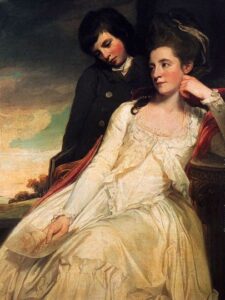 I was originally drawn to the real life character of Jane Maxwell, the 4th Duchess of Gordon (seen with her son in a painting hanging in the Scottish National Portrait Gallery) , because my aforementioned great- grandmother, Elfie McCullough–who lived to be 96–claimed that our McCulloughs from the Lowlands of Scotland were related to the Maxwells of Monreith through marriage a few generations before Jane Maxwell was born. Later I came across an article about her life as the “Match-making Duchess” and was very intrigued that I might be related to such a fascinating historical figure. Sadly, after five years of research, I was never able to prove I was her direct descendant, but the odd thing is, we look rather alike: dark hair, hazel eyes, and a similar bone structure! Read more