A Shakespeare Festival in 1769
August 22, 2010 by ciji · Leave a Comment
 The three actors on your left are performing this summer in New York Classical Theater‘s production of Much Ado About Nothing presented in Central Park. (The handsome gent in the middle is my brother-in-law, Christopher Cass, playing Don Pedro, Prince of Aragon as a Naval officer!)
Shakespeare festivals have been going on so long, their organizers are constantly searching for new interpretations–and certainly new “settings” for some very old plays. This Much Ado is set in 1945 during World War II. (Well, why not?)
It got me thinking as I am readying a new edition of my historical novel, Wicked Company for publication in October of this year from Sourcebooks Landmark. My book centers on the life of the women playwrights whose works were produced to great success at London’s Covent Garden and Drury Lane theaters in the last half of the 18thc.
David Garrick, the actor-manager of Drury Lane, was not only credited with mentoring women playwrights, but also with being the finest Shakespearean actor of his day. As one wag put it, “Garrick elevated the Bard from able dramatist to a God.”
Recently I was proofing the section dealing with the heroine Sophie McGann’s role assisting at Garrick’s famous (some say infamous) Shakespeare Jubilee held on the banks and in the village of Stratford-Upon-Avon in September of 1769. Sadly, the skies opened up and it virtually poured buckets of rain during the entire three-day event, nearly drowning the actors and audiences alike.
Garrick had summoned the finest thespians of the day to join him in the tribute held in Shakespeare’s birthplace, and redeemed the soggy disaster by presenting his “Ode to Shakespeare” –a performance that eyewitnesses said brought down the house (a rotunda, actually) as the water was rising and soaking the slippers of the entire audience. The scholars and intellectuals of the day, including Garrick’s supposed friend, Samuel Johnson, boycotted the event.
 On the left is a highly idealized image of Garrick reciting his Ode. Ever the entrepreneur, he re-staged the washed-out “Parade of Shakespeare Characters” back in London, and whenever the billboards trumpeted the most famous actor of his day was–again–to deliver his Ode to Shakespeare, the house was packed.
Last week, my poor brother-in-law performing Shakespeare outdoors had a similar experience to Garrick ‘s and his actors in 1769. Chris’s Sunday, August 15th performance of Much Ado on the grass in Central Park was just that: nothing. It was rained out!
So what’s new?
A Tale of Two Covers
August 8, 2010 by ciji · Leave a Comment
Anyone who follows the publishing business knows what turmoil the industry has been experiencing since the Dawn of the Digital Age changed all the rules and even the game itself. Nowhere is that upheaval more likely to be felt than in the marketing of books.
I’ve been a frontline witness to this recently. Last Spring I was sent the new cover for Wicked Company, the October Sourcebooks Landmark release of a novel that’s very dear to my heart because it’s about writers; specifically women writers struggling to make their way in the boistrous, bawdy 18th c. world of the famed Drury Lane and Covent Garden theaters. Between 1660 and 1820, there were at least one hundred “petticoat playwrights” who saw their works mounted on the professional stage–many writing under their own names. As an author rather obsessed with the question “what were the women doing in history?”, to me, these amazing artists were perfect fodder for an historical novel.
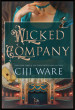
 The cover on the left was sent for my approval last spring and I loved it. The image was an adaptation of the famous Sir Joshua Reynolds portrait of perhaps the most celebrated 18th c. actress-manager in England, Sarah Siddons. Huge in size and grand in scope, it currently hangs at the Huntington Art Gallery in San Marino, California, where I spent several years researching Wicked Company.
Then a funny thing happened on the way to publication day for the new edition: some very key people in the process of getting the book to market had second thoughts about the cover, so back to the drawing boards they went to see if they could both capture the era, as well as reflect a less “static” feeling in presentation, as one book buyer put it.
The final cover is now this you see on the right:  showing a slightly mysterious image of an actress on stage in period dress, framed by red velvet drapes and also sporting the shield that has become a welcome “signature” for this series of my books.
I cannot deny the cover switch hasn’t required some adjustment, as I’d already put it on my new website and was quite pleased about the way it harmonized with the other Sourcebooks Landmark covers in the new series. However, I realize that those professionals who specialize in bringing historical novels to their audiences in this sometimes perplexing digital revolution may know much more about the business of “packaging” and “buyer appeal” than I do, and are wise in the ways of trends in the evolving industry.
Thus, I remain grateful to the talented designers at my publishers who have now created two attractive covers for Wicked Company, and I leave it to the readers of this blog to decide which of the images attracts them the most to a book that was such a joy for this author to write. The cover on the right is the one that will appear in the bookstores, but you, faithful reader, now have the inside scoop on why you may have seen Sarah Siddons vanish back to the eighteenth century.
It’s a new world out there in publishing with books now also available on Kindle, iPad, Nook, and Sony readers, as well as the old fashion volumes made from paper that you can hold in your hands and turn the pages–while soaking in a bathtub!
Let me know what you think, both about the book’s cover and its contents…
My Favorite Authors
July 5, 2010 by ciji · Leave a Comment
 I’m often asked to name a selection of my favorite authors.
Well, anyone who knows me can tick them off quickly: Daphne du Maurier and Anya Seton, but I love Jane Austen, of course, along with Rosamund Pilcher, and a new novelist I’ve discovered who writes Regency mysteries, Tasha Alexander.
I also love Jacqueline Winspear’s Maisie Dobbs series set in the early 20th century, and of course, I love the Sourcebooks/Landmark’s reissuing of the Georgette Heyer legacy. I have to read a lot of nonfiction for the work I do in that genre, so there is no greater pleasure in life, as far as I’m concerned, than to curl up with a juicy historical that sweeps me out of my ordinary day and into the past. I am so grateful that this genre appears to be experiencing a marked resurgence of reader interest! Read more