Visiting Old Haunts in the Big Easy
August 14, 2011 by ciji · Leave a Comment
 The new-and-improved edition from Sourcebooks-Landmark of my second “woo-woo” novel, Midnight on Julia Street hit the bookstores and online retailers August 1, but in June, I had a wonderful chance to revisit some of my old haunts in New Orleans and environs. The American Library Association was holding its convention in the Big Easy and my publisher asked if I’d be willing to sit in their booth and sign books.
Well, yes! Yes, indeed, I would!
Next to my home city of San Francisco, New Orleans is one of my favorite places on the planet. After spending over a year researching Julia Street, I did what so many lovers of that city do: I bought a place in the lower (residential section) French Quarter on Ursulines Street between Dauphine and Bourbon where the pace is slower and the sense of history surrounds you on every corner. We loved our tiny piece of Le Vieux Carre, but after a couple of years, found it difficult to manage it properly from 2000 miles away and have since sold it.
 Since Julia Street’s plot was deeply embedded in the on-going struggle to preserve and maintain the city’s incredible historic architecture, I decided to revisit some of key spots depicted in the novel. On an early, steamy Monday morning, I departed the fabulous view of the Mississippi River from my room at the Sheraton Hotel on Canal Street, and headed over on foot–as does Corlis McCullough, the heroine in the novel–for my favorite morning ritual: a cup of cafe au lait and a beignet at the famed 7/24 establishment Cafe du Monde.
The coffee, of course, was already flowing, though the chairs outside at 6a.m. hadn’t yet been lifted down from the tables where the floor had been cleaned in the wee hours of the morning. As usual, there were lines waiting for that first cup of steaming, chickory-laced brew and the decadent confection of deep-fried puff pastry dredged in about an inch of powdered sugar.
(Tourist tip: do NOT wear anything black when eating a beignet!).
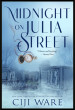
I munched on this ambrosia, read my morning copy of The Times Picayune, gazed across Decatur Street and into the gated park at Jackson Square dominated by the three-spire magnificence of St. Louis Cathedral (which you can see on the cover of Julia Street). I found myself offering up thanks to whatever Muse originally gave me the idea for a book about the good fight waged daily by a stalwart band of dedicated preservationists to save various aging structures around the city from the wrecking ball. The “Live in a Landmark” program and other efforts sponsored by the Preservation Resource Center of New Orleans have gone far to keep the city’s historic “built environment” alive and well–and still live-able.
Once I’d dusted off the powdered sugar that had rained down on my T-shirt and jeans, I began a leisurely stroll through the streets I’d come to know so well. The Rue Royal, as you see here, Ursulines, where we’d owned our cottage, and eventually I circled back to Canal Street where the Salin buildings still stand with their less-than-esthetic 50’s-era metal cage, behind which are a row of stunning 19th century townhouses that some officials in the City of New Orleans and some developers wanted to tear down at one point to build a high rise hotel. The metal cage encasing the old buildings is still there, but so are those precious structures behind it (which you can see a glimpse of, if you look carefully). What makes them especially noteworthy is that in the 19th century they were built and owned by a consortium of local citizens that included Free People of Color, and some prominent white citizens, among them: Paul Tulane of Tulane University fame. It was a very early version of a “Rainbow Coalition” when Cotton was King.
 Apparently, post-Katrina, the fight over this particular issue is at a Louisiana stand-off, but in Julia Street –a work of fiction, remember–I devise a plot (and a fate for these buildings) that I hope the reader finds satisfying. However, I’m not telling what happens, here, but just wanted to share the wonderful time I had in one of the most wonderful, brave, enduring places in America.
Wicked Company Should be a Movie!
September 19, 2010 by ciji · Leave a Comment
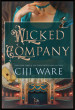
 On October 1, Wicked Company is about to have a new life as a nice, juicy trade paperback, courtesy of my publishers, Sourcebooks Landmark, but really, truly, I think one day it should be a movie on a large screen, in full color, and powered by THX sound!
I hold this opinion not merely because I’m proud of this historical novel–which I am, of course– but because, when I did the research, the images I found in the depths of the Huntington Library, or in the archives of the Theater Museum in London leapt out at me in a fashion that just begs for someone to make a film.
I mean, just look at the cast of characters:
We have King George III, Drury Lane actor-manager David Garrick and his wife, struggling women playwrights like the two Hannahs (Hannah More and Hannah Cowley who hated each other),along with numerous actress-playwrights like Kitty Clive and my fictional villainess, Mavis Piggott, plus the weedy little censor Edward Capell–not to mention the hero and heroine, based on a composite of theatrical figures of the day whose lives I encountered when doing the years of research.
Added to this are the amazing locations of this novel: Edinburgh, Covent Garden, Bath, Stratford, the Welsh countryside, Annapolis, Maryland, even! Theaters on both sides of the Pond became the places I had to visit when researching and writing this book.
As I look over my own photo collection, such wonderful memories rush back. The day I discovered this image of David Garrick about to stab his co-star in an eighteenth century play, now long forgotten, was a red-letter moment.
I even let out an audible yelp in the hallowed bowels of an archive not-to-be-mentioned when I stumbled across an example of the very tickets issued to gain entrance to the first Shakespeare Festival held in Stratford-Upon-Avon in 1769.
 And then there was the day when I uncovered the fact that one of my historical figures, writer James Boswell, had turned up in the pouring rain at the Shakespeare Festival dressed as a Corsican and brandishing a tall, crooked staff in order to promote a book he was writing! I mean, really! Does nothing change?
These are the moments when an author is transported back in time and can see a story unfolding as if it were a film! (From my computer to God’s ears….)
Can Readers Love a “Flawed” Hero?
September 12, 2010 by ciji · Leave a Comment
When I was first conjuring the characters in Wicked Company and mulling over how I would weave both fictional and historical figures into the story of an 18th c. woman playwright fighting to get her works written and performed at London’s Theatre Royal, Drury Lane, I thought about some of the men of that era whose lives clearly could be fodder for a novelist’s imagination and well as an historian’s.
 Take the 18th c. poet Robert Burns, for example, who figured in my first historical novel, Island of the Swans. He was an astonishingly good-looking man, from all accounts and surviving pictorial representations. He also had a reputation for loving the ladies–some of whom were not his wife–and according to the research, there was much gossip surrounding his relationship with my heroine, Jane Maxwell, the 4th Duchess of Gordon.
However, my reading of the facts was that the duchess supported his artistic endeavors, helping to get his first book of poems published in Edinburgh, but held him at arm’s length. Thus, he was not the “hero” in the novel and so I avoided the issue of whether readers can appreciate a lead character who actually lived on this planet, and yet could not be described as a “man of moral character.”
It is part of the territory when writing historical fiction that there is constant tension between creating a compelling story and balancing the historical facts as best we are able to determine them. Readers of novels tend to want their heroes “heroic”–unless they are lovable “anti-heroes,” which can sometimes work but is very tricky to pull off. For me, I enjoy working through the flaws as the story’s arc shows the characters growing and changing while the novel unfolds.
However, sometimes a character is fascinating, but simply not “hero” material to my way of thinking. For instance, in Wicked Company, Richard Sheridan of The School for Scandal and The Rivals fame was a contemporary of my composite heroine, Sophie McGann, a female character drawn from the biographies of several working women playwrights of the day. However, Sheridan had a character flaw that I couldn’t stomach. Yes, he was a compelling gent, not too bad looking as you see here, and of course, a prodigious talent , but in my research I concluded that he basically “borrowed”–with no credit–the famous Mrs. Malaprop character in The Rivals from one his own mother had originally created in a play that failed to pass the censor in the Lord Chamberlain’s office! Interesting, yes. A hero in my book, NO!
In the end, I created a fictional hero, Hunter Robertson, to go with my fictional heroine, but he, too, is noted for his lapses.  Most notable among them is a fair amount of emotional baggage carried over from his youth that prevents him, early in the novel, from seeing what is obvious to the reader: that he and Sophie are destined for each other–a state of affairs he ultimately begins to comprehend when they both become involved in the theater in the beautiful spa city of Bath where, believe it or not, in the 18th c. there were co-ed bathing facilities! (Note the lady holding on to her hat in the upper right of the image).
But to a writer, those flaws Hunter possessed were what kept the writing interesting for me, especially when they’re rooted in conflicts and tragedies going back to a period of his childhood he wanted to forget: a time when his mother chose which of her children to give the meager supply of food during “the starving” in the Highlands of Scotland that came in the wake of the failure of Bonnie Prince Charlie to claim the thrones of England, Scotland and Wales.
I love Hunter Robertson–flaws and all–and I think readers will too, knowing on some level that he will eventually come to terms with his difficult past, recognize Sophie for the valiant, gifted woman she is, and fall madly in love with her. Until that happens, his role is to save her from herself (and her hot temper), as well as find his own path as a creative talent in the boisterous, turbulent London theater world.
For me, heroes are more interesting if they’re not perfect and totally “heroic,” straight out of the gate. Perhaps this is what keeps readers interested in the mystery of how in the world Hunter and Sophie are going to overcome the obstacles facing a “two-career couple” in the eighteenth century!
Truly, nothing much changes, despite our claim to modernity.
Outfoxing “That Little Toad!” Edward Capell, Censor
September 5, 2010 by ciji · Leave a Comment
There is nothing more delicious for an historical novelist than to run across a generally unknown figure in history who is a person to be thoroughly disliked, as with Edward Capell, an 18th c. play censor in the Crown of England’s Lord Chamberlain’s office.
 From all accounts, he had a very high opinion of his own intellect–perhaps deservedly so, as he was considered an expert on the works of Shakespeare and was often asked to authenticate various manuscripts. However, he held the lowest opinion imaginable of a mere woman attempting to earn her living by her pen. Thus, any woman playwright trying to get one of her works past this disapproving bureaucrat and granted a license to be performed on a professional stage in London or elsewhere in the Kingdom faced frustration bordering on the urge-to-kill.
Edward Capell could end any writer’s career with a stroke of his pen, but he apparently took special delight in blindsiding “uppity women,” including a number of woman writers who ultimately took refuge in using male pseudonyms to try to get past his overt prejudice against them.
The “cameo” image on the left is highly flattering, for in life, he was an odd little man, with a penchant of eating foods only the color white! He’d eat mashed potatoes or parsnips, but never orange carrots. He’d consume white cheese, but never cheddar; white wine, but not claret. Such was his odd phobia of foods of vibrant hues, that the lack of vitamins in his diet soon produced scrufulous skin disorders, making his appearance behind his desk at the Lord Chamberlain’s office quite a terrifying sight to behold.
Fortunately, there were a number of clever women writers who managed to get their works approved for production by one means or another, including Frances Sheridan, mother of the far more famous playwright, Richard Sheridan of The Rivals and The School for Scandal fame. Frances, seen here on your right, had a dreadful time running the gauntlet of the Lord Chamberlain’s office, though she managed to see her The Discovery and The Dupe produced under her own name at Drury Lane by David Garrick, the immortal actor and manager there whose fame continues to this day.
Garrick, as you will discover if you read my forth-coming Wicked Company was the best friend an 18th c. woman playwright would ever find, and chroncling his brilliant handling of the dreaded censor, Edward Capell, was one of the most delightful experiences I ever enjoyed as an historical novelist.
When my heroine, Sophie McGann, comes storming into his office shouting, “Oh, how I despise that little toad!” having just learned that Capell has refused her latest play a license, Garrick kindly pats her on the arm and replies, “Well, my dear, we must then simply out fox him. Now, here’s my idea…”
Wicked Company‘s publication date is October 1 and, hopefully, will be in the books stores a bit before that. I hope you’ll love to “despise that little toad” Edward Capell as much as I did!
A Shakespeare Festival in 1769
August 22, 2010 by ciji · Leave a Comment
 The three actors on your left are performing this summer in New York Classical Theater‘s production of Much Ado About Nothing presented in Central Park. (The handsome gent in the middle is my brother-in-law, Christopher Cass, playing Don Pedro, Prince of Aragon as a Naval officer!)
Shakespeare festivals have been going on so long, their organizers are constantly searching for new interpretations–and certainly new “settings” for some very old plays. This Much Ado is set in 1945 during World War II. (Well, why not?)
It got me thinking as I am readying a new edition of my historical novel, Wicked Company for publication in October of this year from Sourcebooks Landmark. My book centers on the life of the women playwrights whose works were produced to great success at London’s Covent Garden and Drury Lane theaters in the last half of the 18thc.
David Garrick, the actor-manager of Drury Lane, was not only credited with mentoring women playwrights, but also with being the finest Shakespearean actor of his day. As one wag put it, “Garrick elevated the Bard from able dramatist to a God.”
Recently I was proofing the section dealing with the heroine Sophie McGann’s role assisting at Garrick’s famous (some say infamous) Shakespeare Jubilee held on the banks and in the village of Stratford-Upon-Avon in September of 1769. Sadly, the skies opened up and it virtually poured buckets of rain during the entire three-day event, nearly drowning the actors and audiences alike.
Garrick had summoned the finest thespians of the day to join him in the tribute held in Shakespeare’s birthplace, and redeemed the soggy disaster by presenting his “Ode to Shakespeare” –a performance that eyewitnesses said brought down the house (a rotunda, actually) as the water was rising and soaking the slippers of the entire audience. The scholars and intellectuals of the day, including Garrick’s supposed friend, Samuel Johnson, boycotted the event.
 On the left is a highly idealized image of Garrick reciting his Ode. Ever the entrepreneur, he re-staged the washed-out “Parade of Shakespeare Characters” back in London, and whenever the billboards trumpeted the most famous actor of his day was–again–to deliver his Ode to Shakespeare, the house was packed.
Last week, my poor brother-in-law performing Shakespeare outdoors had a similar experience to Garrick ‘s and his actors in 1769. Chris’s Sunday, August 15th performance of Much Ado on the grass in Central Park was just that: nothing. It was rained out!
So what’s new?