How to Build a Cottage in Your Mind
March 2, 2013 by ciji · Leave a Comment

I admit it: over the years, I’ve become a rather obsessed “cottage collector.” Perhaps it’s because, at around ten years old, I began visiting my Grandfather Ware at the tiny stone cottage perched on a sand dune on Carmel Beach that he rented the same year we moved as a family from Los Angeles to the amazing village of Carmel-by-the-Sea. My father, writer Harlan Ware, would escort me along the streets-with-no-sidewalks to the Forest, Studio, and Golden Bough theatres thriving in our town where I would perform in semi-professional plays when I was growing up. We’d pass by cottage after cottage that could have served as illustrations in the Book of Mother Goose. Cottage life, to me, seemed an idyllic way to live, even during the years when I dwelled in the cities of New York, Los Angeles, and San Francisco.
 So, when I first walked through this gate fifteen years ago on the central coast of Cornwall, England on a research trip for A Cottage by the Sea, I knew this was the perfect spot to set this story and had in my mind exactly how the fictional “Painter’s Cottage” should look. It would be a stone structure with a slate roof and floor-to-ceiling artists’ windows facing the English Channel. However, on that day, all I could see across a broad field was a tiny structure clinging to the cliff on a curving bay between Nare Head on the West and Dodman Point to the East.

As I picked my way across the loamy turf, I began to make out what was actually an abandoned “lookout” stone structure, a small, squat building–and in 1997, minus a roof. Never mind, I thought, enraptured by the sweeping view and the sheep and Scottish Highland cattle dotting the slope, this was the place I would build my perfect cottage in my imagination. On another research trip years later to prepare for the sequel, That Summer in Cornwall, the field’s owner—the Caerhays Castle estate–had recently restored the roof, perhaps in the hope they could add it to a list of estate outbuildings they offer to paying guests. Luckily for me, I had that privilege last October at Bottom Lodge…once the gatekeeper’s cottage.
 Talk about a novelist surrounding herself with the atmosphere of the place she would write about! This is “Bottom Lodge” where visitors to Caerhays Castle (aka “Barton Hall” in my two novels set in Cornwall) can book into the left turret. I was “in residence” in October of 2012 and it was totally an experience of a lifetime! I spent my days tramping all over the estate, reveling in what it must have actually been like to live here a hundred and fifty years ago, and also got a solid grasp of what a struggle it is in the modern world to keep these big houses solvent.
 In the two, stand-alone novels (and certainly in my mind), I easily expanded the small structure I’d spotted perched on the cliff into a two-story cottage with a sleeping loft and a faintly baronial fireplace opposite windows facing the English Channel–and no cattle wandering in and out! (This cottage with the sailboat actually exists in Talloires, France–but I loved the fireplace and imagined it as part of Painter’s Cottage!) On my most recent trip to the environs of Gorran Haven in central Cornwall, I dared to get pretty close to those long-horned Scottish Highland cattle who’d made the old stone lookout hut their personal shelter…and what a view! Beyond those clouds, that’s Brittany across the English Channel…
The vistas through the abandon lookout’s glass-less windows were even more incredible. Imagine, I thought, if the Caerhays Estate eventually rehabs this stone lookout and allows their “paying guests” to stay here as they did with bottom Lodge? But I loved the location so much, I decided as I was writing That Summer in Cornwall that the heroine would claim the “newly rehabbed” Painter’s Cottage for her own while she pitched in to help her Anglo-American cousins return the eight-hundred-acre estate to solvency.
 I could easily imagine the overstuffed furniture in front of a cozy fireplace, surrounded by the magnificence of the Cornish coast. To me, Painter’s Cottage truly exists as part of a shabby-chic castle clinging to a remote Cornish cliff–even if all you can see if you visit there this very day is a small, squat, abandoned stone hut that may one day see new life again.
In a novelist’s mind, anything is possible…
That’s What Friends Are For…
February 17, 2013 by ciji · Leave a Comment
 A quite remarkable phenomenon is percolating among the community of multi-published novelists. It’s more than a “you scratch my back, and I’ll scratch yours” book promotional network, but rather a curated, semi-underground system of authors who know, trust, and admire each other’s work and are willing to give a shout-out on their own book blogs and on Facebook, Twitter, etc. to a sister novelist who has a new book being launched by the author-as-publisher.
This is especially true these days due to the fact that some very respected non-novelist book bloggers have thrown in the towel trying to keep up the the avalanche of new titles and have shut down their blogs that formerly trumpeted the wares of both experienced and novice novelists to the reading public.

A few bygone book bloggers cited the online abuse they encountered from some publishers and/or authors if they didn’t describe a new novel in the noblest of terms and award it with a “5 Star Review.” Cried one plaintively on her final posting: “For some, 4.5 stars was an insult. I just want to get back to what got me into blogging in the first place: reading and writing about the books I love!”
Frankly, who could blame them?
 Meanwhile, an increasing number of established writers with many traditionally published books under their belts are now venturing into the world of “Independent Publishing,” declaring that they feel they deserve more than 7-15% of the profits when others involved in bringing their books to the public are taking a whopping 40-70% of the “take” on a book that has been created by the person who actually wrote it. For unnumbered scribes, it simply has become a case of “Do the math!’
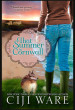
And then there is something so satisfying to click the “upload” button and see the colorful cover of a novel like That Summer in Cornwall appear on the major online retail sites like Amazon, Barnes & Noble and Apple/iBooks (by February 22). In March, the print version is scheduled to debut via the usual online retailers and, hopefully, in a bookstore near you….
Frankly, it’s nothing short of shouting from the rooftops: “Look, Ma…I’m a Publisher!”
But, writing the book is only Step 1 and preparing it for release–merely Step 2. Step 3 is that no-man/woman’s/land of promoting and marketing an independently produced novel to the readers who might like it among virtually millions of other titles floating out there in cyberspace.
 Suddenly the author living the solitary life locked in a room with only a computer for company is thrust into the world of Facebook, Twitter, Pinterest, Tumblr, Goodreads, and all the other “engines” designed to get the word out to an audience that one hopes actually wants the new novel on their bookshelves or electronic reading devices.
Which brings me to the title of this blog: the extraordinarily generous novelists in my circle of friends and professional acquaintances who have been kind enough to invite me to “guest post” about That Summer in Cornwall on their blogs and other online outlets. I offer up my deepest thanks to pals like Cynthia Wright, Julie Kenner, Michael Llewellyn, and Lauren Royal who have been big boosters of my first foray into independent publishing. As blogs where I’ve been a contributor move on to newer topics, they’ve allowed me to re-post my “guest appearances” on Ciji’s Blog—which I will be doing in the next little while.
Hey, what are friends for?
And I am more than happy to do the same, especially for these open-hearted, talent authors. In this Brave New World, we have to forge new paths and alliances based on honesty and appreciation–and how better than to walk those paths than with people you like and trust?
Rescue Dogs and the Making of a Subplot
February 13, 2013 by ciji · Leave a Comment
 Like many millions on our planet, I love animals and have had a cat or a dog in my world virtually all my life. My current pooches, seen here around Christmastime, are two Cavalier King Charles Spaniels: Ensign Aubrey and Charlock (a.k.a Cholly Knickerbocker). They prove to me each day that dogs teach us our best lessons about noble behavior and unconditional love.
Around the time I was noodling about the plot for my stand-alone contemporary sequel to the “time-slip” novel I wrote nearly fifteen years ago, A Cottage by the Sea–Hurricane Issac was bearing down on the Gulf Coast. One day last August, I did an Internet search to see if an amazing group based in Ojai near Santa Barbara called the Search Dog Foundation would be sending dog/handler teams as first responders, an assignment they have shouldered for many of the cataclysmic events this past decade: 9/11; the Oklahoma City bombing; hurricanes Katrina, Sandy, and the earthquake in Haiti, and even traveling as far as Japan after the earthquake and tsunami in 2011.
 I began to drill down deeper on their amazing website and learned more about their fantastic work of rescuing dogs languishing in shelters (where many unadopted animals, sadly, are ultimately put to death) and then training these lucky canines survivors to be part of search-and-rescue teams all over the United States. The Search Dog Foundation, the brain child of the amazing Wilma Melville (on left, red jacket), is in the process of building a $14 million dollar K9 training “ranch” where firefighters and police officers are brought together with their newly-graduated “partners.” As I gazed at their intriguing picture gallery on the site—I had a major epiphany!
The new book would return to central Cornwall where a craggy, windswept coastline, woods and moors often lured “day trippers” to this glorious part of Britain into dangerous situations requiring all out search and rescue efforts. Did first responders in the UK use dogs on their search-and-rescue teams, I wondered?
 On my first Google look-see, up popped all volunteer “Cornwall Search and Rescue Team”—and the stellar men and women who employ air-scenting dogs to help find missing persons who may have fallen off a cliff or down one of the many abandoned tin or copper mines in the area, or have wandered into trouble on the rough terrain of the many moors.
As I dug further into this subject, a sub-plot unfolded effortlessly: that of stories about these wonderful people who bring others to safety in cooperation with official “rescue” organizations and institutions such as the Royal Air Force, H.M. Coastguard, and the local constabularies of Devon and Cornwall that coordinate both military and civilian enterprises engaged in search-and-rescue work. Hey, even Prince William is a part of this world!
And then another brainwave! Why couldn’t the hero be a veteran in the dog bomb-sniffing squad, late of the British forces in Afghanistan? I remembered seeing an image of a TDH (tall, dark and handsome) fellow in a Ralph Lauren ad who was the perfect “model” for Sebastian Pryce, a mysterious figure that returns to Cornwall with a newly-trained search dog—and some secrets of his own.
He suddenly appears at Barton Hall, a shabby-chic castle on a remote cliff near the village of Mevagissey, with the novice T-Rex, a Border Collie who very inappropriately attempts to have his way with a female dog on the estate belonging to an American woman who just stepped out of a battered Land Rover!
 Suddenly the “search dog subplot” became key to the entire novel, That Summer in Cornwall, about this same American who is stunned to learn that she is now the legal guardian of a child she’s never met. At the urging of the child’s Anglo-American aunt (Lady Blythe Barton-Teague, heroine of the first novel), Meredith Champlin and her eleven-year-old “Beverly Hills Brat” decamp for Cornwall for the summer and—
Are you surprised I felt the need to return to the enchanting land of my Ware ancestors to refresh the research? The workings of a novelist’s mind are mysterious, indeed…
Downton Abbey in Modern Dress?
February 4, 2013 by ciji · Leave a Comment
Authors write sequels for many reasons, but That Summer in Cornwall, just published January 31 as an e-book at Amazon, Barnes & Noble, iTunes/iBook, (print version available in March, 2013), came about because I always wondered what happened to the Anglo-American couple, the former Blythe Barton Stowe, and the life peer, Sir Lucas Teague after they joined forces to save the slightly down-at-the-heels Barton Hall from financial ruin at the end of my bestselling A Cottage by the Sea.
When a storyline “ten years later” began to percolate in my mind, I set off last October to reacquaint myself with the original “Barton Hall”—the wonderful Caerhays Castle perched on a cliff in mid-Cornwall overlooking the moody English Channel where Blythe had escaped to Painter’s Cottage to rid herself of the paparazzi chasing one of Tinseltown’s juicier scandals. Soon, I began worrying what life would be like—now– for the almost-illegitimate child, Janet, born to Blythe’s first husband, the “cinematic genius” Christopher Stowe, and Blythe’s sister, Ellie Barton—the pair who blew Blythe’s marriage to smithereens in the first book.
 It was so wonderful to be back along the coast of Cornwall, which stretches as far as the eye can see some one hundred miles across the water from the French coast of Brittany. This region is actually the land of my own Ware forebears, so there was an added incentive to return to the territory I’d visited several times in the last fifteen years when researching A Cottage by the Sea.
For the new novel, I was now able to “book in” at Caerhays Castle in the wonderful Bottom Lodge, the gatekeeper’s cottage across from Portluney Beach, a smugglers favorite landing spot in days of yore. I was also there to research the remarkable world of volunteer search and rescue teams in Cornwall, including the amazing “air-scenting” dogs who find people who plunge off cliffs, down deserted mine shafts, or get lost on the moors.
The surprise more than a decade later was to see how beautifully the model for the fictional Barton Hall depicted in both novels had been cared for since my last visit, now that “paying guests” helped keep the coffers filled at this eight-hundred acre estate whose village church is some seven hundred years old!
Faced with the same problems confronting Julian Fellowes’ characters in Downton Abbey, the owners of Caerhays grappled with the notion of offering members of the public the opportunity to come to shoot pheasant in autumn, see the glorious Rhododendron gardens in spring, and pause for a nice “cuppa” in the castle courtyard when the weather is fine. The owners appear to have made a wonderful transition from “To the Manor Born” to “Open for Business”—and I wish them every success as they, like the Crawleys of Downton, seek–and find–new ways to make these enormous houses “sustainable.”
Booksellers, Historical Fiction, & “Hand-Selling”
October 4, 2010 by ciji · Leave a Comment
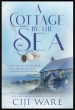
 I remember walking into the (now) 83-year-old independent Tecolote Bookshop in Montecito, California–seen here hosting Thomas Steinbeck at a signing–to show them the galleys for the first edition of A Cottage by the Sea. My favorite member of the small sales force peered at the title and then suddenly clutched the Advanced Reader’s Copy to her bosom and said with a sigh, “Oooooh, a cottage by the sea…every woman’s fantasy!”
I was extremely gratified to hear this as I was in a fierce battle with the book’s original publisher about the title. “They” wanted to change it, and I loved it and wanted to keep it.
I immediately sent an emergency fax (that’s how long ago this was) to the editor, recounting exactly what I’ve told you.
I knew this anecdote would have some weight because the scuttlebutt was that Tecolote was one of the up-market independent booksellers out West that the New York Times Sunday Book Review called to measure sales for its bestsellers’ list. I have no idea if that is true, but it was an accolade from an important store and, bless the hardworking staff there, it carried enough clout with the editors and marketers in New York to retain the book’s title!
 Every since that time, I have done my best to support and get to know the booksellers at both independent bookshops, like my local Habitat Books seen here, as well as the chain bookstore staffs in my area.
Historical novels, whether made of paper or downloaded onto an electronic reading device, are successful in great part due to this “hand-selling,” and I’ve been grateful for the fifteen years that A Cottage by the Sea has been in print in its various editions that booksellers have apparently given it a personal boost and created that “buzz” that can really make a difference in sales.
Just this morning I was walking with a friend down our main thoroughfare where the tourists stroll as soon as they step off the ferry from San Francisco, and lo and behold, there was the beautiful edition (and new cover) of Cottage–out since June of this year from Sourcebooks Landmark–up-front-and-center in the window of the store! I’ve met the owner, but hadn’t had a chance to go in and try to twist her arm to stock the book, to say nothing of begging her to put it in the window.
I handed my dog-walking pal my iPhone and said, “Quick! Take a snap, will you? I want to prove to the world how the independents are truly independent!” The owner chose to feature the book with no prompting from the author or publisher.

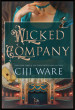
Books are sold by hand by these wonderful people who own bookstores…one book at a time. And now that the new edition of Wicked Company, about a group of women playwrights whose works were produced to great success at London’s Covent Garden and Drury Lane theaters, is about to debut this month, I guess I should get busy, go into Habitat Books to show them the new cover, and introduce myself again….
I’ve done that recently at a local gift shop, It’s Out of Hand, whose owner, Christine Butler, I know well.  Since we live in a maritime village facing San Francisco Bay, she put Cottage near the cash register with a sign “Signed by Local Author” and sells several copies a month talking about the similarities between Cornwall, England, where Cottage is set, and the California coasts along Carmel-by-the-Sea and Big Sur.
Another lesson in “books are hand sold, one book at a time.” Words to live by, I’d say.