Writers’ Conferences 101
October 11, 2010 by ciji · Leave a Comment
 Fall and spring in pretty places–that’s pretty much the routine when it comes to holding writers’ conferences, and the Scribblers’ Retreat is no exception! Held quarterly, the next one is November 10-14 at the King and Prince Beach and Golf Resort –shown here–on gorgeous St. Simons Island, Georgia and will feature historical novelists like Diana Gabaldon and yours truly, along with my publisher, Dominique Riccah, CEO of Sourcebooks.
I just got the promotional material that kindly said: “Ciji Ware, veteran of all forms of print and electronic media, will talk about “New Publishing Trends–or–How I Survived as a Scribe.” Certainly a timely topic, given the revolution (and convolutions) going on in the print and publishing worlds, and when a visitor to this site merely clicks from page to page, you can certainly deduce that the main message I probably want to convey is: keep writing–no matter what!
 That is how one gets to be a “veteran.” As my sainted late father, Harlan Ware, used to say about producing reams of material over his professional writing career, “Writers write. They don’t make excuses. They put the seat of their pants on the chair and their hands on the keyboard and they keep typing!”
And if you’re me, you start at about 9a.m. at least five days a week, as you can see from the image of a former (very mess) office on the right.
Maybe “Writers Write” should be inscribed within view of every would-be novelist or scribe. If you click on the “Ciji’s Covers” page on this site that displays the eight books I’ve written, you’ll see what comes from being consistent. To earn my keep, I’ve also written nonfiction, 2 screenplays (neither so far produced), a play (produced in my home town), magazines, news, television, and radio copy, online articles for the web, e-books, e-guides–you name it, I’ve typed it!
I usually mention this when I speak publicly, and offer forth other bits of wisdom from my father who wrote screenplays,novels, a biography, short stories, and for fourteen of its twenty-seven years on the air, the radio classic One Man’s Family: “The best way to be a writer who can pay the light bill is to pretend you work for the phone company. Punch the clock, day in, day out.”
Not every budding writer wants to hear this message of how to survive as a professional scribe. They want to write “when the spirit moves them….” or when their head is full of vibrant, fabulous ideas. And that’s fine, if writing is a hobby. But if it’s a living, there’s only one way to survive, and that’s to, as they say in the Nike commercial: “Just DO it!”
 When I taught “Writing the First Novel” as an adjunct professor at the UCLA Extension Writers’ Program, I had 17 members in my class, and only one of them finished a book. The next year when I taught “Writing Women’s Fiction”–same thing. One person completed her manuscript and the rest of the class never crossed the finish line. I was worried that perhaps I wasn’t a great teacher, but the supervisor running the program looked up my student evaluations and said, “No…you got great marks from your class. It’s just they never understood how hard it can be to write a book, to say nothing of getting it published.”
Apparently, nearly every lawyer would like to be John Grisham, but few have the stamina to work as hard at the writing craft as Grisham has. Hundreds of people over the years have said to me, “Oh….I’d love to write a book, if only I had the time,” or “I know a great book that you should write!”
 I haven’t spoke to a full-fledged writers conference for quite some time, lecturing mostly these days about my nonfiction work Rightsizing Your Life: Simplifying Your Surroundings While Keeping What Matters Most. But now that all my historicals are being reissued with wonderful covers from Sourcebooks Landmark–and my first new historical novel in a decade will be published next April–it’s going to be interesting to see if audiences of fledgling authors who “love to write” have changed at all, especially as it has become tougher and tougher to earn one’s living in the Digital Age.
I’ll let you know how it goes….
Booksellers, Historical Fiction, & “Hand-Selling”
October 4, 2010 by ciji · Leave a Comment
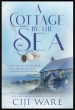
 I remember walking into the (now) 83-year-old independent Tecolote Bookshop in Montecito, California–seen here hosting Thomas Steinbeck at a signing–to show them the galleys for the first edition of A Cottage by the Sea. My favorite member of the small sales force peered at the title and then suddenly clutched the Advanced Reader’s Copy to her bosom and said with a sigh, “Oooooh, a cottage by the sea…every woman’s fantasy!”
I was extremely gratified to hear this as I was in a fierce battle with the book’s original publisher about the title. “They” wanted to change it, and I loved it and wanted to keep it.
I immediately sent an emergency fax (that’s how long ago this was) to the editor, recounting exactly what I’ve told you.
I knew this anecdote would have some weight because the scuttlebutt was that Tecolote was one of the up-market independent booksellers out West that the New York Times Sunday Book Review called to measure sales for its bestsellers’ list. I have no idea if that is true, but it was an accolade from an important store and, bless the hardworking staff there, it carried enough clout with the editors and marketers in New York to retain the book’s title!
 Every since that time, I have done my best to support and get to know the booksellers at both independent bookshops, like my local Habitat Books seen here, as well as the chain bookstore staffs in my area.
Historical novels, whether made of paper or downloaded onto an electronic reading device, are successful in great part due to this “hand-selling,” and I’ve been grateful for the fifteen years that A Cottage by the Sea has been in print in its various editions that booksellers have apparently given it a personal boost and created that “buzz” that can really make a difference in sales.
Just this morning I was walking with a friend down our main thoroughfare where the tourists stroll as soon as they step off the ferry from San Francisco, and lo and behold, there was the beautiful edition (and new cover) of Cottage–out since June of this year from Sourcebooks Landmark–up-front-and-center in the window of the store! I’ve met the owner, but hadn’t had a chance to go in and try to twist her arm to stock the book, to say nothing of begging her to put it in the window.
I handed my dog-walking pal my iPhone and said, “Quick! Take a snap, will you? I want to prove to the world how the independents are truly independent!” The owner chose to feature the book with no prompting from the author or publisher.

Books are sold by hand by these wonderful people who own bookstores…one book at a time. And now that the new edition of Wicked Company, about a group of women playwrights whose works were produced to great success at London’s Covent Garden and Drury Lane theaters, is about to debut this month, I guess I should get busy, go into Habitat Books to show them the new cover, and introduce myself again….
I’ve done that recently at a local gift shop, It’s Out of Hand, whose owner, Christine Butler, I know well.  Since we live in a maritime village facing San Francisco Bay, she put Cottage near the cash register with a sign “Signed by Local Author” and sells several copies a month talking about the similarities between Cornwall, England, where Cottage is set, and the California coasts along Carmel-by-the-Sea and Big Sur.
Another lesson in “books are hand sold, one book at a time.” Words to live by, I’d say.
Word Wenches
September 27, 2010 by ciji · Leave a Comment
 Last week, a great writer pal of mine, Mary Jo Putney, seen here at left, asked if I would “guest blog” on a great site for historical and romance novel buffs: Word Wenches. MJ and some other terrific scribes like Jo Beverly and Patricia Rice have been posting their musings, thoughts, notions, and passionate opinions about their work and the writer’s craft for a couple of years, now, and are considered among the best practitioners of the blogging craft on the Web.
I had a great time and after my stint, was granted an “HWW:” an Honorary Word Wench award, which to my mind is to be highly prized…
MJ and I decided I was vastly qualified to do a riff on a subject close to my heart: how much covers can make or break a book, a situation that is particularly true when it comes to historical versus romance fiction.
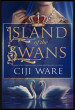
As I said in the Word Wench piece (and elaborated here on a blog post of my own entitled A Tale of Two Covers regarding my forth-coming Wicked Company), what I find so fascinating is the way books are truly categorized by their covers. Readers obviously take their cues from the images depicted on the front of a book. Here are two radically different approaches to editions of the first novel I ever wrote, Island of the Swans.
 The new Sourcebooks Landmark trade paperback cover on the left incorporates the actual 18th c. portrait of the heroine, Jane Maxwell, 4th Duchess of Gordon by George Romney, hanging now in the Scottish National Portrait Gallery.
  The Bantam mass market paperback cover on the right used modern models and classic poses used to promote romance fiction.
Romance readers know what they like and expect, and the same holds true for lovers of historical novels. If the covers don’t match the content, readers can, rightly, become highly incensed—and I don’t blame them. As with Island of the Swans and Wicked Company, my other novels always include a love story, but each one also centers on the question “What were the women doing in history?” To answer that query, the books by necessity must be extensively researched as to the role of a very small segment of the population–women who earned their own keep in a day far removed from our own.
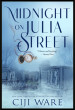
The idea that a few, talented and brave females longed for self-expression in various fields that were then the exclusive provenance of men is also central to the dual story historical/contemporary titles I’ve written: A Cottage by the Sea, Midnight on Julia Street, and A Light on the Veranda.
 From the earliest days of my career when I held at Readership in British-American History at the hallowed Huntington Library in San Marino, California, I’ve been fascinated by “professional women” in the 18th and 19th centuries and have chosen to tell the stories of female politicians, artists, writers, and musicians—all based on composites of women who really lived and plied their various crafts for money.
The problem was, the books I wrote in the 1980’s and 90’s as full-on historical novels about these “famous-but-forgotten” women of history were often saddled with some God-awful covers during the period when nearly every historical was thought to have a better chance in the marketplace if it emphasized the romance more than the history.
But bless Sourcebooks/Landmark for creating a “look” this time around that matches the contents of my historicals, so that hardcore romance readers can steer clear of them if they so chose, and lovers of historical fiction (who don’t object to a love story threaded through the narrative) might give them a try!
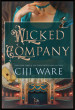
May all the readers of both the Word Wenches blog and my own blog feel so inclined October 1, when the new cover of Wicked Company–originally given an equally misleading earlier incarnation–hits the stands this time around looking like this…
 .
.
…instead of this….
Wicked Company Should be a Movie!
September 19, 2010 by ciji · Leave a Comment
On October 1, Wicked Company is about to have a new life as a nice, juicy trade paperback, courtesy of my publishers, Sourcebooks Landmark, but really, truly, I think one day it should be a movie on a large screen, in full color, and powered by THX sound!
I hold this opinion not merely because I’m proud of this historical novel–which I am, of course– but because, when I did the research, the images I found in the depths of the Huntington Library, or in the archives of the Theater Museum in London leapt out at me in a fashion that just begs for someone to make a film.
I mean, just look at the cast of characters:
We have King George III, Drury Lane actor-manager David Garrick and his wife, struggling women playwrights like the two Hannahs (Hannah More and Hannah Cowley who hated each other),along with numerous actress-playwrights like Kitty Clive and my fictional villainess, Mavis Piggott, plus the weedy little censor Edward Capell–not to mention the hero and heroine, based on a composite of theatrical figures of the day whose lives I encountered when doing the years of research.
Added to this are the amazing locations of this novel: Edinburgh, Covent Garden, Bath, Stratford, the Welsh countryside, Annapolis, Maryland, even! Theaters on both sides of the Pond became the places I had to visit when researching and writing this book.
As I look over my own photo collection, such wonderful memories rush back. The day I discovered this image of David Garrick about to stab his co-star in an eighteenth century play, now long forgotten, was a red-letter moment.
I even let out an audible yelp in the hallowed bowels of an archive not-to-be-mentioned when I stumbled across an example of the very tickets issued to gain entrance to the first Shakespeare Festival held in Stratford-Upon-Avon in 1769.
 And then there was the day when I uncovered the fact that one of my historical figures, writer James Boswell, had turned up in the pouring rain at the Shakespeare Festival dressed as a Corsican and brandishing a tall, crooked staff in order to promote a book he was writing! I mean, really! Does nothing change?
These are the moments when an author is transported back in time and can see a story unfolding as if it were a film! (From my computer to God’s ears….)
Can Readers Love a “Flawed” Hero?
September 12, 2010 by ciji · Leave a Comment
When I was first conjuring the characters in Wicked Company and mulling over how I would weave both fictional and historical figures into the story of an 18th c. woman playwright fighting to get her works written and performed at London’s Theatre Royal, Drury Lane, I thought about some of the men of that era whose lives clearly could be fodder for a novelist’s imagination and well as an historian’s.
 Take the 18th c. poet Robert Burns, for example, who figured in my first historical novel, Island of the Swans. He was an astonishingly good-looking man, from all accounts and surviving pictorial representations. He also had a reputation for loving the ladies–some of whom were not his wife–and according to the research, there was much gossip surrounding his relationship with my heroine, Jane Maxwell, the 4th Duchess of Gordon.
However, my reading of the facts was that the duchess supported his artistic endeavors, helping to get his first book of poems published in Edinburgh, but held him at arm’s length. Thus, he was not the “hero” in the novel and so I avoided the issue of whether readers can appreciate a lead character who actually lived on this planet, and yet could not be described as a “man of moral character.”
It is part of the territory when writing historical fiction that there is constant tension between creating a compelling story and balancing the historical facts as best we are able to determine them. Readers of novels tend to want their heroes “heroic”–unless they are lovable “anti-heroes,” which can sometimes work but is very tricky to pull off. For me, I enjoy working through the flaws as the story’s arc shows the characters growing and changing while the novel unfolds.
However, sometimes a character is fascinating, but simply not “hero” material to my way of thinking. For instance, in Wicked Company, Richard Sheridan of The School for Scandal and The Rivals fame was a contemporary of my composite heroine, Sophie McGann, a female character drawn from the biographies of several working women playwrights of the day. However, Sheridan had a character flaw that I couldn’t stomach. Yes, he was a compelling gent, not too bad looking as you see here, and of course, a prodigious talent , but in my research I concluded that he basically “borrowed”–with no credit–the famous Mrs. Malaprop character in The Rivals from one his own mother had originally created in a play that failed to pass the censor in the Lord Chamberlain’s office! Interesting, yes. A hero in my book, NO!
In the end, I created a fictional hero, Hunter Robertson, to go with my fictional heroine, but he, too, is noted for his lapses.  Most notable among them is a fair amount of emotional baggage carried over from his youth that prevents him, early in the novel, from seeing what is obvious to the reader: that he and Sophie are destined for each other–a state of affairs he ultimately begins to comprehend when they both become involved in the theater in the beautiful spa city of Bath where, believe it or not, in the 18th c. there were co-ed bathing facilities! (Note the lady holding on to her hat in the upper right of the image).
But to a writer, those flaws Hunter possessed were what kept the writing interesting for me, especially when they’re rooted in conflicts and tragedies going back to a period of his childhood he wanted to forget: a time when his mother chose which of her children to give the meager supply of food during “the starving” in the Highlands of Scotland that came in the wake of the failure of Bonnie Prince Charlie to claim the thrones of England, Scotland and Wales.
I love Hunter Robertson–flaws and all–and I think readers will too, knowing on some level that he will eventually come to terms with his difficult past, recognize Sophie for the valiant, gifted woman she is, and fall madly in love with her. Until that happens, his role is to save her from herself (and her hot temper), as well as find his own path as a creative talent in the boisterous, turbulent London theater world.
For me, heroes are more interesting if they’re not perfect and totally “heroic,” straight out of the gate. Perhaps this is what keeps readers interested in the mystery of how in the world Hunter and Sophie are going to overcome the obstacles facing a “two-career couple” in the eighteenth century!
Truly, nothing much changes, despite our claim to modernity.