If These Castle Walls Could Talk…
April 5, 2013 by ciji · Leave a Comment
 There are travelers who will tell you, “You’ve seen one castle, you’ve seen ‘em all,” but when I’m in the throes of constructing a novel set in Great Britain, castles seem to me as important as “characters” as any of the humans that populate my stories.
Each of these fortresses has its own, specific story to tell: who built them and why? What were they trying to protect? Who was born here; who died here? And most importantly…who loved—or hated—their fellow inhabitants here?
Call me the Ultimate Romantic, but over the years of researching my various historicals, I sometimes think that the stones  whisper their tales…if the traveler can just remain quiet enough to hear what they have to say.
 I felt that “presence” of those who had come before so vibrantly at Caerhays Castle, the turreted stone edifice that was the model for “Barton Hall” in That Summer in Cornwall. It’s round towers and views of the English Channel and the lonely lookout cottage on the property’s cliff conjured up a story that practically told itself.
Now that I’m in the midst of the preliminary research for That Autumn in Edinburgh which will focus on the descendants—one Scottish, one American—of the star-crossed lovers in my first novel, Island of the Swans, I find myself also plotting my trip to the Scottish Border territory south of Edinburgh.
Here I’ve set up an interview with the man who has spearheaded the mulit-milion dollar refurbishment of Sir Walter Scott’s Abbottsford where I’ve recently discovered the novelist’s family were intermarried with descendants of Jane Maxwell, 4th Duchess of Gordon, the heroine of Island of the Swans whose clan once inhabited this ominous turreted fortress on the right.
 And then there’s Ayton Castle, the forerunner of the now-destroyed Ayton House where Jane received a letter a month following her arranged marriage to the Duke that the great love of her life had not died in an American Indian skirmish outside Fort Pitt, Pittsburgh, and was coming home thinking to claim her as his own.
Knowing this story, how would a modern Maxwell male descendant, struggling to keep a traditional tartan mill afloat–along with a Fraser, visiting from America in an attempt to recover from a tragic loss of her own– feel as they walked the banks of the River Eye on the exact spot where Jane learned of her lover’s survival, far too late for her to find lasting happiness with Lieutenant Thomas Fraser?
Asking a simple question like that…and listening intently to the standing stones and rustling wind might easily spark a writer’s imagination…
A “Petticoat Playwright” Wannabe
August 29, 2010 by ciji · Leave a Comment
 In the late 1980’s, just about the time I had finished researching and writing my first historical novel, Island of the Swans, I stumbled across a reference to a minor character I’d included in the book , the sister of the heroine, Jane Maxwell, 4th Duchess of Gordon (1749-1812). I discovered that the duchess’s younger sibling, Eglantine, Lady Wallace, not only enjoyed playing the harp for guests in her home, as you see here, but also penned three plays.
One, The Ton: or, Follies of Fashion was produced in 1788 to a distinct lack of success at London’s Covent Garden theater; the second, The Whim, was forbidden a license by the official censor in the Lord Chamberlain’s office; and the third, an adaptation from a French play, Diamond Cut Diamond, suffered a fate that has been lost in the mists of time. Frankly, I was amazed to have learned that women were writing plays for London’s finest theaters during the 18th c.–many under their own names, as was the case with Lady Wallace for The Ton.
I remember walking into the Rare Book room at the Huntington Library in San Marino, California, where I held a Readership in 18th & 19th c. British-American History, and putting in three call slips, certain these obscure manuscripts were only to be found in a dusty corner of some library in London. (No books circulate outside these types of research libraries, so you can see how many tomes began to pile up on my desk as time went on with this project!)
Much to my shock, the Huntington had all three plays! Not only that, they had scores more dramas and comedies written by eighteenth century women playwrights because more than seventy years before, Henry Huntington’s acquiring agents bought the Larpent Collection of plays from the heirs of a long-dead censor in the Lord Chamberlain’s office, the bureaucracy that, up until the early 1960’s, determined which plays could be presented in Britain.
In fact, in the course of researching and writing Wicked Company, I learned that there were a hundred women playwrights in Britain and America who saw their works produced on professional stages between 1660 and 1820. While in London, I had the pleasure of back stage tours of the latest “editions” of Covent Garden and Drury Lane theaters (both places have burned to the ground several times due to the candles used to light the proceedings prior to the invention of electricity).

That moment when I held a copy of Eglantine, Lady Wallace’s failed play in my hand marked the start of a three-year odyssey to discover professional women playwrights whose works were produced to great success–unlike poor Eglantine–at the theatres royal, Covent Garden and Drury Lane, an image of the latter you see here.
Finding the failed plays of this “petticoat” playwright wannabe also provided the avenue that eventually led me to Edward Capell, a strange little functionary who had the absolute power to end the writing careers of these professional women playwrights with the stroke of his pen. Capell was destined to become one of the most intriguing “villains” I’ve ever had the pleasure to create!
But more about this mean, spiteful little toad next time…and I’ll even post an image of what he looked like…
Wicked Company, by the way, will be in bookstores in October, courtesy of Sourcebooks Landmark, and I can’t wait!
The Idea for a Novel Comes From…
July 12, 2010 by ciji · Leave a Comment
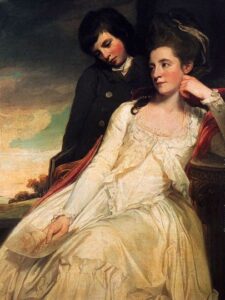 I was originally drawn to the real life character of Jane Maxwell, the 4th Duchess of Gordon (seen with her son in a painting hanging in the Scottish National Portrait Gallery) , because my aforementioned great- grandmother, Elfie McCullough–who lived to be 96–claimed that our McCulloughs from the Lowlands of Scotland were related to the Maxwells of Monreith through marriage a few generations before Jane Maxwell was born. Later I came across an article about her life as the “Match-making Duchess” and was very intrigued that I might be related to such a fascinating historical figure. Sadly, after five years of research, I was never able to prove I was her direct descendant, but the odd thing is, we look rather alike: dark hair, hazel eyes, and a similar bone structure! Read more
Revisting Jane Maxwell
June 14, 2010 by ciji · 2 Comments
 In revisiting something this writer penned two decades earlier, it was invigorating to think about the qualities of my heroine in Island of the Swans– Jane Maxwell, the 4th Duchess of Gordon—and the qualities in her that I so admired…and to evaluate whether my portrayal was truly a close characterization of her.
I think I portrayed her as near reality as a writer could while still remembering to be a “storyteller”—which is the first duty of historical novelists, in my view. Read more